
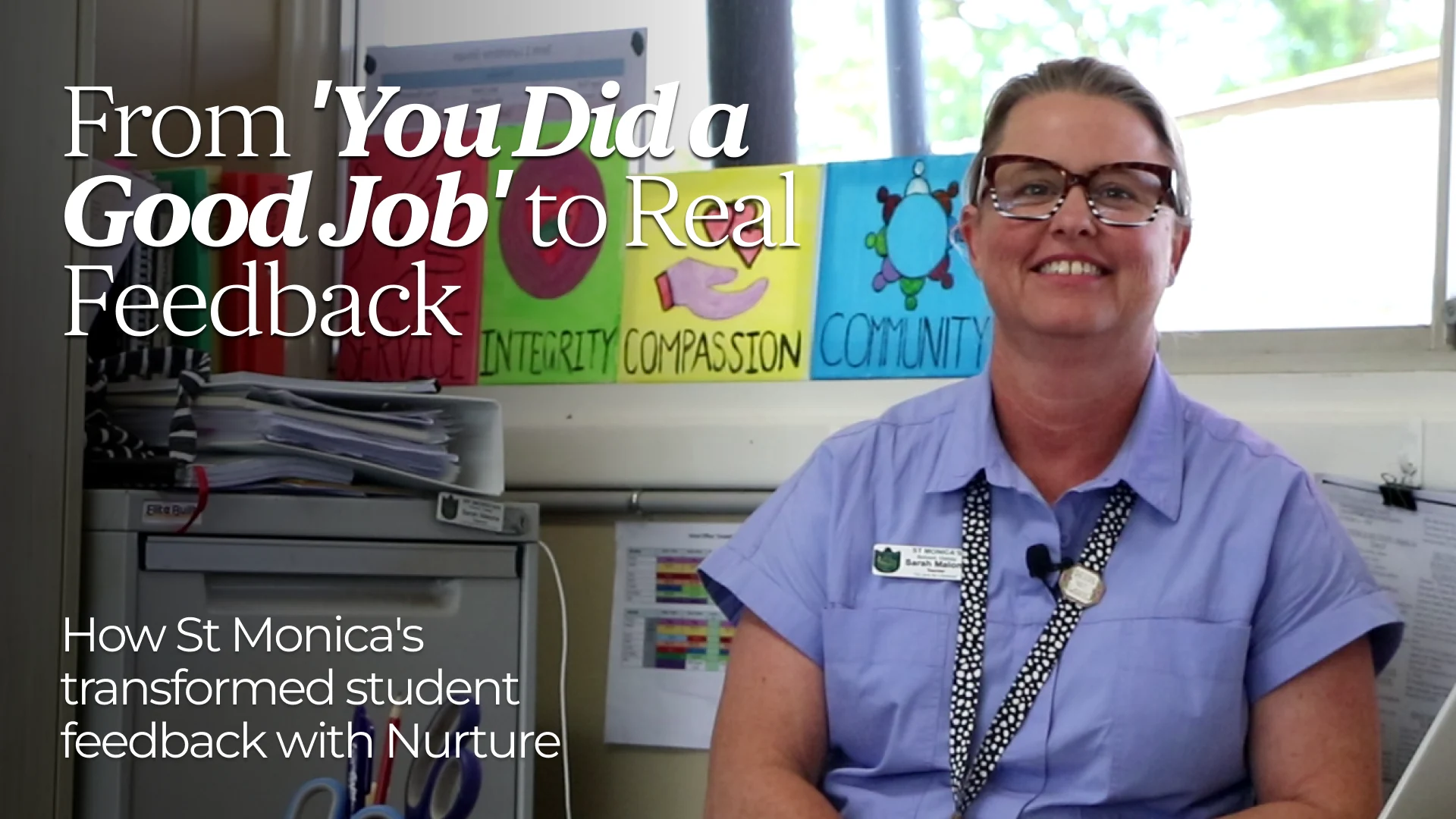
From 'You Did a Good Job' to Real Feedback : How St Monica's transformed student feedback with Nurture
St Monica's Primary School, Oakey

Australia
The Challenge
Good Intentions, No Time
Sarah has been teaching at St Monica’s Primary School in Oakey, Queensland for long enough to know what good feedback looks like. She’s seen the difference it makes when a student understands not just that something didn’t quite land, but exactly why — and what to do about it. The problem was never intention. The problem was time.
“Prior to Nurture, I think we never really prioritised feedback,” she says. “We tried to, but because of the time constraints we just never had the time to go into depth with feedback.”
In a busy primary school classroom, the maths is unforgiving. A class of thirty students. A writing task every week. Even five minutes of genuine, specific, written feedback per student adds up to two and a half hours of marking — and that’s before grading, lesson planning, pre-tests, and everything else that fills a teacher’s day. So feedback, despite its importance, got squeezed. Students received ticks, brief comments, and the kind of well-meaning but ultimately vague encouragement that leaves a learner no clearer on what to actually do next.
The students felt it too, even if they didn’t have the language for it at the time. Arabella, now in Year 6 at St Monica’s, put it simply when asked what feedback looked like before Nurture: “I didn’t really get much feedback before it. I would just get like, ‘you did a good job.’”
It wasn’t that Sarah’s feedback was unhelpful — it’s that there wasn’t enough of it, and what there was couldn’t go deep enough. Ruben, one of Sarah’s highest-achieving writers, expressed a similar frustration. For a student at his level, generic praise like ‘try a few more paragraphs’ offered nothing to build on. He needed to know specifically what he was doing well and where the ceiling was. He wasn’t getting that.
This is the gap that exists in classrooms everywhere — not a gap in care or effort, but a structural gap. Teachers who genuinely want to give their students rich, actionable feedback simply cannot do so at the volume and frequency that learning requires. The feedback loop was broken at the source, and no amount of goodwill could fix it without changing something fundamental about how feedback gets made.
“
Prior to Nurture, we never really prioritised feedback. We tried to, but because of the time constraints we just never had the time to go into depth. Whereas now we can read through what the AI has generated for us, modify it to suit our students, and give specific feedback to help them improve and see where they go.
St Monica's Oakey — Sarah — Teacher — The Challenge
Teacher, St Monica's Primary School, Oakey
The Solution
One platform shared across every school
When St Monica’s began using Nurture, the first thing Sarah noticed wasn’t a smooth rollout. It was surprise — and not entirely the good kind. The platform was generating feedback at a depth and level of specificity that her students had never encountered before.
Where they were used to a brief comment or a grade, they were now receiving detailed, structured responses that identified recurring patterns in their writing, named specific strengths, and laid out clear, personalised targets for improvement. For some students, it was genuinely confronting. “When we first started using Nurture, it was probably a little bit confronting for them because of the depth of feedback that they were getting — it was quite overwhelming for some of them,” Sarah recalls.
This reaction was real and understandable. Students who had only ever received surface-level responses were suddenly being told, in precise terms, what they were doing well and what needed work — and the latter felt, at first, like criticism. Arabella describes the initial feeling honestly: “When you first get it, you’re like, I did a really bad job at this, it’s not really good.”
But that reaction didn’t last. For most students, the more they read, the more the feedback started to make sense not as a judgment, but as a roadmap. “The more you look into it,” Arabella says, “and if you don’t understand it and get your teacher to help explain it, it’s actually really just trying to help you make your writing even better so you can be an even better writer. And I’ve learned from that, and it’s really what’s made me a good writer, I think.”
Ruben’s experience was slightly different — characteristically confident — but pointed in the same direction: “I don’t really think it’s really bad straight away just because I saw a bit of bad feedback. I straight away just look into it more and then I realise what I’ve done wrong and I use that to improve my writing later.”
Sarah watched this shift happen across her class and built structured classroom practice around it. She introduced a ‘two wishes and a star’ reflection exercise: students identify two things from their feedback that went well, then set one specific goal for their next piece of work. It turned the feedback from something that happened to them into something they were actively using.
Critically, Nurture’s feedback didn’t just tell students what to fix — it showed them how. Sarah highlights this as one of the most practically valuable aspects of the platform: “I really like that you can include examples so that instead of just saying, ‘use more descriptive vocabulary,’ it will show you how to do that — it will give them examples in their writing and how to improve that way.”
For the other students in the class — Charli and Sienna, who had their first experience with Nurture during this period — the learning curve was visible in real time. Both started their session feeling neutral or uncertain. By the end, having read through their feedback and reflected on it, the shift in confidence was noticeable. “At the start I felt neutral, sort of okay, not very confident,” Charli said. “And then once I got the feedback, I felt a little bit more confident because I got good feedback on my writing.”
The platform’s self-reflection feature — where students submit an emoji and an optional comment to their teacher about how they feel before and after receiving feedback — gave Sarah a window into this emotional journey that she hadn’t had before. Students were sending her notes about how they felt going in, then updating her after they’d read their results. It created a line of communication that didn’t require putting your hand up in front of the class.
“
Testimonial quote text goes here from the referenced testimonial.
Attribution Name
Job Title
The Result
Too Much Feedback, Then Just Right
The transformation at St Monica’s hasn’t been dramatic or overnight — it’s been steady, concrete, and unmistakeable to the people inside the classroom.
Sarah describes a class that has fundamentally changed its relationship with feedback. Where the previous year’s cohort was hesitant, the current group is engaged and hungry for it. “This cohort have really embraced using it. They want to know their feedback. They’re excited now to know where to next and how they can improve.”
For Ruben, the most obvious change is in his writing itself. He can trace his improvement in descriptive language directly back to the specific feedback he has received through Nurture over the past year and a half. “Today it said that I use really amazing descriptive language,” he says, “and last year I didn’t use nearly as much.” He mentions his own writing with easy confidence now — a hive golden sunlight shining onto an arm — the kind of detail that comes from someone who has learned to notice and craft language, not just someone who’s been told to be more descriptive. Beyond vocabulary, he has also changed how he approaches feedback itself, moving from scanning it quickly to reading it carefully. “I read a bit more instead of just scanning over it really quickly, and actually understand why it was negative or positive feedback, rather than just saying the base or most simple bit of it.”
Arabella’s growth has shown up in a different but equally striking way. The quality of her thinking — and her peers’ thinking — about their own work has gone up noticeably. Where last year, sharing a piece of writing with a classmate would generate feedback like ‘this part was good, I didn’t like the end,’ now those conversations are richer. “Now, because we’ve used Nurture, it’s like ‘this part was really entertaining and exciting, and I didn’t like this part because…’ It’s really good now.” She has also developed more range as a writer. Last year, she wrote the same type of story for an entire year. This year, with better prompts and more structured feedback, her ideas have broadened.
Sarah notes one particular student moment that captures what the shift looks like at its best: Ruben, one of her highest-level writers, finally getting feedback that was commensurate with his ability. “It was really great for him to say that he’s finally getting feedback that can help him improve his writing rather than the generic, ‘you’ve done a really good job, try a few more paragraphs.’” For a student like Ruben, that matters enormously. Generic praise has a ceiling. Specific feedback doesn’t.
The students themselves have internalised this distinction. Arabella’s favourite feature of Nurture is the ability to add a private note to her teacher when submitting — a small but significant thing. “It’s kind of weird to put your hand up in front of everyone and just talk about your story,” she says. “I think it’s really good that you can just give a little note to your teacher like, ‘I think this is good, but I don’t really like it.’” Ruben, for his part, values what he sees as the impartiality of the platform: “Sometimes when you’re asking a friend or occasionally even a teacher to give you feedback, it can be really bland and not actually go into detail — because Nurture analyses all of it, and it doesn’t really have a consciousness, so it won’t get bored of saying stuff, and it’s just going to give you feedback on every bit of it.”
For Sarah, the impact is also personal. Nurture hasn’t just changed what her students receive — it has changed what she is able to give. “We can read through what the AI has generated for us. We can modify it to suit our students. And it has just really helped me be able to give specific feedback to kids to help them improve and see where they go.”
Beyond writing, she has extended her use of the platform to create quick pre-assessment tasks in maths — a ten-question diagnostic that gives her an immediate snapshot of where each student is sitting, helping her decide what to reteach and what to skip. The time she saves on feedback generation is time she reinvests in teaching.
Feedback at St Monica’s is no longer something that happens occasionally, briefly, and generically. It is specific, structured, and — for the students on the receiving end — something they look forward to.
“
Testimonial quote text goes here from the referenced testimonial.
Attribution Name
Job Title
Section Four Eyebrow
Section four heading goes here
Section 4 body content goes here. Bind this to the Section 4 Body rich text field.
Heading 1
Heading 2
Heading 3
Heading 4
Heading 5
Heading 6
Lorem ipsum dolor sit amet, consectetur adipiscing elit, sed do eiusmod tempor incididunt ut labore et dolore magna aliqua. Ut enim ad minim veniam, quis nostrud exercitation ullamco laboris nisi ut aliquip ex ea commodo consequat. Duis aute irure dolor in reprehenderit in voluptate velit esse cillum dolore eu fugiat nulla pariatur.
Block quote
Ordered list
- Item 1
- Item 2
- Item 3
Unordered list
- Item A
- Item B
- Item C
Bold text
Emphasis
Superscript
Subscript
“
Testimonial quote text goes here from the referenced testimonial.
Attribution Name
Job Title
Section Five Eyebrow
Section five heading goes here
Section 5 body content goes here. Bind this to the Section 5 Body rich text field.
“
Testimonial quote text goes here from the referenced testimonial.
Attribution Name
Job Title


